10 Reasons Why Guys Without Beards Are Awesome

13915752234_aa64330359_z This is discrimination, I thought.

Last week, I had clicked on a link some people were sharing. As I read the article, I couldn't help but feel like I was inferior in some way because of my genes. Some emotions I felt: Anger. Shame. Jealousy. Hunger. (Those other emotions really get a guy's appetite going.)

The article was called "7 Obvious Reasons You Need to Date a Guy with a Beard."

In it, the author makes a case for the power of a man's beard. She says things like, "(A girl) knows that even a decent five o’ clock shadow can transform any dork into a rugged, mountain-climbing hunk." And "There’s a reason why Allie went back to Noah in The Notebook — and we all know it was his beard."

I took offense to this. I still do. I'm pretty upset by it, and you'd be able to tell if you were here with me in person because there's no beard on my face to mask the reddening of my skin.

As my bearded friends love to remind me, I'll never be able to match their manliness because I can't grow a beard. My five o'clock shadow starts to come in about...two days after I shave.

Well.

I've made my own list in response. This is:

THE TOP TEN REASONS WHY GUYS WITHOUT BEARDS ARE AWESOME

1. Guys without beards have nothing to hide. Especially their beautiful faces.

2. Guys without beards don't have chunks of last week's potato salad still hanging around their chins.

3. You'll never have to ask yourself, "Is this person normal, or is he the next Una-bomber?" when you see a guy without a beard.

4. You won't feel like you're bushwhacking through Mirkwood Forest when you kiss a guy without a beard.

5. Guys without beards are smarter, stronger, and faster than guys with beards. That's science.

6. Guys without beards can teleport through time and

Okay, fine. I can't think of ten reasons.

Beards are awesome, we all know it, and I want one.

Ladies, go find your bearded Ryan Gosling. The rest of us beardless guys will just have to settle to date Sarah Michelle Gellar in Buffy the Vampire Slayer marathons.

If you'll excuse me, I have work to do, because I have to pay for the $80,000 I spend on razors every year.

(Fun fact for beardless guys: If a bearded guy is holding a young child, tell the kid to pull on the fun thing hanging off that guy's face. It'll make you feel better for at least a minute.)
 
***
 Feature photo ©2014 Mark Tighe | Flickr

Review: The Giver--How I'd Like to Forget

the-giver-movie

Sometimes, when a bad memory pops up, I quickly shake my head to get rid of it. Sort of like clearing an Etch-a-Sketch. And they intrude on my thoughts quite a bit:

The time in second grade when my gym teacher wouldn’t let me go to the bathroom and I wet my pants during calisthenics, and a golden puddle formed around my designated white dot on the concrete.

Shake. Gone.

The regrettable period of my life when I actually thought Abercrombie & Fitch was cool.

Shake. Gone.

The Etch-a-Sketch method works in the short term, but the real problem is that those memories always find their way back onto the canvas of my thoughts. If only there was a way to wipe them clean for good, to drop those files into the trash can, empty that trash can, and erase it all from my hard drive. I wouldn’t have to be bothered with them, to relive the pain or the humiliation. If I was given the option to erase those memories permanently, I may be a little tempted.

Director Phillip Noyce explores that very idea in the film The Giver--what if we did away with the memories of the past? Not our silly mistakes and hiccups, or our blush-inducing, cringeworthy incidents from elementary school, but the world’s past. What if we erased and started over, and tried it better this time? “Better” being relative, of course.

The story features a teenager named Jonas (Brenton Thwaites) who lives in an isolated community presumably at some point in the future. Everything in this community is based on the idea of control because, as its icy Chief Elder (Meryl Streep) puts it:

“If people have the freedom to choose, they choose wrong.”

At some point in the past, generations and generations ago, the powers-that-be decided to take freedom of choice away and create a sterile, safe world. They control the climate, they have removed all color, and they keep people in line with a plethora of rules to ensure that order prevails. Everyone wears the same thing. No one is permitted to touch another person outside of their “family units.”

The story starts to pick up steam when the Chief Elder explains that Jonas has been selected for the community’s highest honor--the Receiver of Memory. It’s a prestigious position of utmost importance, she explains, and will come with very taxing and painful training. Jonas will be trained by the current Receiver of Memory, whom we will come to know as the Giver (Jeff Bridges).

When Jonas begins his training, the Giver, an elderly bearded man with a slight tic, sits him down for his first session as the new Receiver. While Jonas thinks that he’s there to receive memories of the Giver’s past, the Giver explains that it’s not his personal past that will be shared--it will be the world’s.

Thus begins a journey for Jonas as he discovers, through the vivid reliving and transmission of these memories, all that his community lacks--animals, colors, real pain, war, and most tragically, love.

To be honest, it’s difficult for me to look objectively at Noyce’s film on its own as a cinematic experience--I have strong ties to the story. The movie is based on a children’s novel written by Lois Lowry that goes by the same name. Lowry wrote it in 1993 and subsequently won the Newbery Medal for it in 1994. The book has enjoyed immense popularity--it’s sold over 10 million copies and is regarded as an important enough work that it’s included as a required book in the curriculum of schools across the country. Its presence in schools is, in fact, the reason why I first read it.

I had decided in college that I wanted to be an English teacher. When it came time for me to be assigned to a school for student teaching, my supervisor had presented me with a choice: I could take a position in a high school but it would be an hour or more out of town, or I could stay in town but work in a middle school.

Middle school? My blood ran cold for a minute. Middle school is a house of horrors. Or so I had heard. I had it on very good authority (basically every person I had ever talked to) that middle school students were hormonally unbalanced and because of that imbalance were unruly, crazy, awkward, immature, and--oh yeah--were the spawn of Satan. Still, even considering what I knew, I valued staying in town for my student teaching placement above all. There really was little choice.

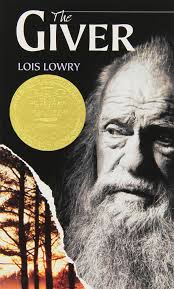
So like Jonas, I accepted my assignment to this middle school with some anxiety. It was there that a short, bleach-blonde veteran teacher, wearied from years of teaching and much like Jeff Bridge’s character the Giver, passed on her knowledge to me. She gave me my first assignment--a small paperback book with the black-and-white photograph of an old man’s wrinkled face on the cover. A shiny Newbery filled the black space next to the old man.
thegivercover

“The first book you’re going to teach the kids is The Giver,” she said in her soft, reassuring voice. “It’s one of my favorite books. It will be yours, too.” I don’t know if was a Jedi-mind trick, but it did become one of my favorite stories. It was a pleasure not only to read it, but to teach it to these middle school students (who turned out to be wonderful, by the way) and help them explore, many for the first time, the ideas of why we need memories (even painful ones) and the freedom to choose, even if we choose wrong. I’ve had the privilege and joy of teaching this story for six years now.

When I first saw the trailer for The Giver, I scoffed. First, because if I’m going to be honest, I always dreamed that I would write a screenplay for The Giver and become rich and famous and take selfies with celebrities all day because I assume that’s what a one-hit wonder screenwriter does. So forgive me if I’m a little upset that Jeff Bridges has stolen that from me (Jeff Bridges played a significant role in making this movie happen). Second, for as short as the trailer was, it gave away some of the key spoilers of the story. As I tell my students, spoilers are my biggest pet peeve. To prove my point, last month, as I introduced The Giver to my current crop of eighth graders, I warned the students not to spoil anything in the story for others if they happened to read ahead. One day, a student, as we were discussing the story in class, mentioned what I’ll call a low-grade spoiler. If these spoilers were a tornado, they would be an F-1.

As soon as the words left her mouth, my eyes contracted and twitched with anger. I happened to be holding a yard stick in my hand (the discussion was about how the community disciplines its children with “discipline wands”)--I tossed it to the ground in disgust, stormed out of the room, and yelled, “I’M DONE--I QUIT!”

Fortunately, the students knew I was joking (or was I?). The offending student even brought me two cookies later that day (See? Middle school is great). The point is, I hate spoilers, I hated the trailer, and I hated Jeff Bridges even more.

Still, considering the importance of the novel to what I do, I saw the movie. I went by myself late on a Sunday night and caught the last showing. I and some other lonely guy in his mid forties wearing a Dad jacket were the only ones there. What I first noticed about the movie was that the first several minutes were dominated by voice-over narration of Jonas. This would be a recurring trend through the rest of the movie. While famed writing instructor Robert McKee advises against voice-over narration, and for good reason because The Giver’s narration proved to be far too textual and over-explained far too often, I found a positive in it: it allowed for a good amount of Lois Lowry’s language from the book to make its way into the movie. Ultimately, the narration proved to hold the audience’s hand and guide it through the story like a seeing eye dog does the blind rather than create a story that takes the reader along for the ride.

The film is loaded with a few A-list actors--Jeff Bridges, Meryl Streep, Katie Holmes as the mother of Jonas--and also features some brief appearances by Taylor Swift as Rosemary, the previous Receiver of Memory who failed ten years prior to Jonas’ selection. Meryl Streep’s performance is the only one that stood out as above average--she brought just the right mix of cold reserve and ruthlessness befitting of her position as Chief Elder. Jeff Bridge’s take on the Giver, with his tics and his slurred speech, made me see the character as more comical than the immensely pained, sad, weary, and burdened man I’ve come to know in the novel. As for Taylor Swift--I know a grown man shouldn’t be admitting this, but I’ll say it--I’m a huge fan of her. Huge. In this movie, though, I was not. Not that she did a terrible job--it just seemed so out of place and reeked of a tickets ploy using star power. Beyond that, the performances by relative unknowns Thwaites as Jonas and Odeya Rush as Jonas’s romantic interest, Fiona, were suitable to the task, but neither made too much of a lasting impression.

By the end of the movie, which was only 97 minutes long, I felt a little shortchanged. This complex, subtle story that I’ve spent so much time with over the last six years felt like it had been pared down with a cheese grater, melted with a few new flavors and synthetic substances, and plopped out as an underwhelming, dancing jello mold.

The story’s themes and conflicts were less four-course meals and more half-price appetizers. I understand that a book has to be chopped a bit to make it to the big screen. I understand that I have an above-average emotional attachment to this story. I still say that the movie fell short of delivering the emotion that the story deserves. Maybe it has to do with the run time; maybe it has to do with the fact that the audience has very little to discover since, for much of the story, the narration told them what was happening and how to feel.

Perhaps, one day, I’ll be bold enough to try my hand at a screenplay for The Giver despite Jeff Bridges beating me to the punch. Hollywood’s memory regarding reworked movies is short enough, right?

Time Is On Our Side

4961717384_f4da868db6_z

On most days, I view time as my enemy: everything I do is a race against it, an effort to slow it down or reverse it.

That's most days. But not today.

Today, I want to slow down. I don't want to fight the ticks of the clock's hands. I don't want to try to paddle against its current.

Sometimes, we work and fight and try and work some more for whatever it is we want in life, but the last ingredient we need to bring it all together is time.

This is for those of you who have done all you can do, or are doing all you can do, and now need to let time do its thing.

Some of us, we need time to heal...

...time for our bones to set.

...time for our tissue and tendons to thread back together.

...time for our ears to stop ringing from words fired from the chamber of a gun.

...time for our hearts to find the rhythm of love and trust again.

Some of us, we need time to forget...

....forget the shame that clings to our skin like August humidity.

...forget our old ways, our little destructive habits.

...forget the hands, the lips that bruised us.

...forget the hands, the lips that once loved us.

...forget the hot, burning sting of our disappointments.

Some of us, we need time to remember...

...remember what it's like to be free from our addictions, our regrets, our darkness.

...remember what makes us come alive.

...remember the notes and the melodies of the songs that make us sing.

...remember what's worth the risk and the sacrifice.

...remember why we loved in the first place.

Some of us, how we need the time...

...time to outrun our fears.

...time to find our way out of the fog.

...time to stumble into hope again.

...time to dust off our dreams.

...time for the stars to come into focus.

...time for the sun to finally show its face again.

Let's allow time to do the work we can't do, to carry us beyond our limitations, expand our near-sightedness, and erode our stubborn vices.

Time doesn't always have to be our enemy. Time can heal, and time can reveal.

Time is on our side.

***

Feature photo ©2010 Sean MacEntee | Flickr

My Most Important Work

12292857216_da660329c9_z I'm having a realization as I stare at my iPhone's calendar, full of dots that represent meetings, events, obligations, get-togethers, classes, and appointments.

It's a slightly scratchy feeling that gnaws at the spots I can't reach with my arms as I buzz through my days. Days sucked dry with all the waking, walking the dog, ironing, packing lunches and changes of clothes, eating, commuting, teaching, emailing, texting, social media-ing, eating, reading, studying, working out, driving, class-ing, grocery shopping, laundry-ing, and...more eating.

That feeling, I know, originates from my to-do list (my to- do lists, more accurately) and crawls around my skin and at just the right moment, when I've stopped to catch my breath or close my heavy eyelids, I hear it say:

You can't get all of this done.

The worst part?

It's right.

If anyone is need of some space, some margin--it's me. I like to keep telling myself that it's because of grad school, that this is just a season that will be over at some point. However valid or not that reasoning is, the fact remains that I can't, and I won't, get everything done.

As much as that bothers me, as much as I hate the feeling of incomplete tasks and the cackling jeers of unchecked items on my to-do lists, I've come to a place of calm in my chaos. It's not resignation; it's more like fog lights that cut through the morning mist enough to allow me to see just enough to move forward. In this season of plenty-to-do, there's one question I've been asking myself and using as my north star:

What is my most important work?

It's a crucial question for me. For a while now, I've been privileged to not have to deal with the problem of not having work. Instead, I have the challenge of never-ending work. The piles of tasks I have seem to regenerate faster than the rate at which I make them disappear, and a line has formed out the door.

Rather than tackle these tasks the way a restaurant kitchen would handle its food tickets--one at a time, in chronological order--I've spent a lot of time asking myself what's most important, and devote my energy to that first. Why? Because when this season of life is over for me--in six months, a year, two years, or whenever--I don't want to look back and realize that I neglected what actually mattered.

So what is my most important work?

It's taken me years of working through trials and errors, getting lost, chasing the wind, disappointments, heartbreak, selfishness, pride, foolish ambitions, blind optimism and reeling cynicism, sky-high triumphs and rock-bottom failures, abundance and near-poverty, company and loneliness--to realize that my most important work is people.

Achievement can be great. Accolades can be great. Awards and accomplishments and all that jazz can be great.

But God forbid that a student comes into my class in September, leaves in June, and never hears me say, "Good job." Never hears me say, "I believe in you." Never knows what it feels like to have someone who is rooting for them.

God forbid that I lead a group of people and they never know that I am for them. That I care more about who they are than what they can do for me.

God forbid that I arrive in one piece at the end of this season of plenty-to-do and a friend has slowly fallen apart and hasn't heard me once ask, "What is going on with you? What challenges do you have right now? How can I help?"

God forbid that I waste my words trying to promote myself, or criticizing people, or spreading cynicism, when I've been given such power to bring light and hope in what I say and write.

God forbid that I reach some goal of mine, pay off my debts, build my platform, publish my work, improve my students' test scores, speak about some important topic, play some decent music, but have the people who are important to me not know what it's like to experience my love for them.

What a tragedy I'd have on my hands.

What a shame it would be to have missed the forest for the trees.

How long it's taken me to realize what my important work is...and how sad it would be for me to neglect it, knowing what I know.

In this season of plenty-to-do, I will undoubtedly make mistakes. I will allow certain tasks to slip through the cracks. I will disappoint someone at some point. All of this will grieve me to some extent.

But it's nothing compared to the grief I'll feel if I look back and my most important work hasn't been done.

Cutting through the chaos, shining through the fog, singing a melody over the noise, are the beating hearts of the people I care about and am privileged to have in my life.

They are my work.

You are my work.

I hope I get that job done.

What about you? What's your most important work?

Feature photo ©2014 Ingrid Eulenfan | Flickr

#LiveTogether: (Not So) Great Expectations

6712184693_4120da670e_z.jpg

We're continuing the #LiveTogether series, in which we take a look at the highs and lows and in-betweens of doing life with people.

I'm excited for today's post--it's from my good friend, Sarah Gurley. Enjoy!

***

When I was four years old, my dad found me crying on the floor of my bedroom, buried by my dolls and a palpable sense of anxiety.

“Why are you crying?” his concerned voice asked.

My pre-school self tearfully responded, “Because I don’t know who I’m going to marry.”

At four years old, it was silly. Juvenile. Innocent.

But then 23 rolled around, and I had yet to experience a real romantic relationship. I’m not talking about holding hands at lunch, or circle “yes” or “no” notes; make-out buddies or a date here and there. No. A real relationship. A partner. Someone you can depend on. An automatic plus-one to the prom. A “you hang up first” wave of nausea for anyone unfortunate enough to be within earshot.

I saw it perpetually happening to my roommates and friends. College was the absolute worst place for someone grappling with singleness. While everyone eagerly coupled up around me, I stood firm on my island of solitude. Who needs a man, anyway? I’ve got my ambition and body pillow, dang it.

I moved to South Korea after college graduation to seek adventure. After all, I made it out of college without a significant nibble on my romantic fishing lure--why not move halfway around the world and ride out this single wave while I’m young? I packed away my yearning for romance, locked it in a box and left it under my childhood twin bed. Let it collect dust; see if I care. I was headed to the Land of the Morning Calm where I most assuredly would not find a romantic interest.

But the unthinkable greeted me upon my arrival. I met someone. As soon as my feet found the sweltering Korean ground, a fetching, blonde-haired New Yorker started to show interest. Not just casual interest either. We’re talking Ethan Embry in “Can’t Hardly Wait”, ridiculously in like with me. So I did what any relationship amateur would do. I jumped in feet first.

But there was a problem.

After that day my dad found me in my bucket of self-pity tears, I spent the next 19 years racking up expectations and ideals for whoever would eventually fill the role of significant other in my life. Everything from appearance and talents to personality type and disposition were accounted for.

This poor guy didn’t stand a chance.

I finally found an eligible male who was head-over-heels for me, and three weeks into our relationship, I dumped him over a plate of Korean dumplings (the irony in our food choice was not lost on me). One may ask why on earth would I break up with a guy who was kind, compassionate, caring, handsome and all-around wonderful?

Simple: he didn’t fit the bill.

I started my collection of expectations before I even hit puberty. And without a significant relationship in my past to give me a healthy dose of reality, those expectations ballooned. What started as an innocent “that would be nice”  multiplied into countless dealbreakers. I didn’t have to give a reason for the breakup other than, “He’s just not what I’m looking for.”

This guy in Korea didn’t have the right profession. He was a teacher. I wanted a pastor. He wasn’t super musical. I wanted someone to write songs with. He was blonde. I wanted a guy with dark hair. He was super athletic. I wanted someone less…hunky. (Editor's note from Paul: All of the nerds of the world are thinking, "Where was I when you were single??") Sure, he had everything else I was looking for but to my novice and nitpicking heart, what he lacked drowned out the whispers of his outstanding qualities.

We parted ways.

Then, something curious happened. My mom, whose opinion I esteem more than just about anyone’s, told me I was being a self-centered, unrealistic, hypocritical idiot (not in so many words, but that was her gist).

She didn’t want my unrealistic expectations and ideals inhibiting me from experiencing life to the fullest. We can’t all marry Ryan Gosling, sigh.

We’re always going to find something in our significant other that doesn’t quite fit the bill; nobody is perfect. But life isn’t comprised of rigid puzzle pieces needing to fit together just so. If that were the case, we’d spend 50% of our time looking for that specific person and the other 50% stressing over whether or not we already missed him/her. But have you ever put together a worn-out, old puzzle that has eroded and chipped pieces? What was once a beautiful landscape is faded and filled with gaps. When the pieces no longer fit perfectly, what’s the use? It’s not worth the effort so you just throw the puzzle away.

What I didn’t realize was that by racking up all those expectations, I was setting myself up for a temporary, throw-away puzzle of a relationship. Even if he fit my 23-year-old self, would we still fit together at 33? 57? 81? By going in with a checklist of qualities, I was preventing myself from experiencing the wonderful unpredictability of love.

I took a few months to rid myself of my unyielding plans and expectations. I threw my puzzle pieces away and instead embraced moldable clay. Where one piece pushes, the other can give way to allow for the new formation. A beautiful, flexible push and pull where chips and gaps are simply rubbed away.

One day, the guy came back around and asked if I wouldn’t mind giving it a go again. He hadn’t changed during that time apart. He was still a semi-musical, hunky, athletic, blonde teacher. But after sloughing off my own expectations and preparing myself to jump in sans deal breakers, I found myself falling in love with this unsuspecting gentleman in a far-away land.

A wedding, two adorable children and seven years later, he’s still creatively exceeding my original expectations each and every day.

***

Sarah is a travel-addict who leads worship and teaches bible at a private boarding school in Western New York. When not reading age-inappropriate YA novels or searching couch cushions for lost binkies, she spends time with her hunky husband and two daughters. You can check out her book reviews and mom rants at Paperbacks & Pacifiers

Feature photo ©2011 Aric Cortes | Flickr